

The Japanese yen gained ground against the eurodollar in the Asian session yesterday following the report of better-than-anticipated trade surplus data by the Japanese Ministry of Finance. Even the industrial output data was not as bad as anticipated.
Still, the eurodollar managed to regain the lost ground in the European session on rising optimism about a robust economic rebound in the coming months. With an increase in risk-on sentiment, market participants are moving out of the yen, traditionally regarded as a haven currency.
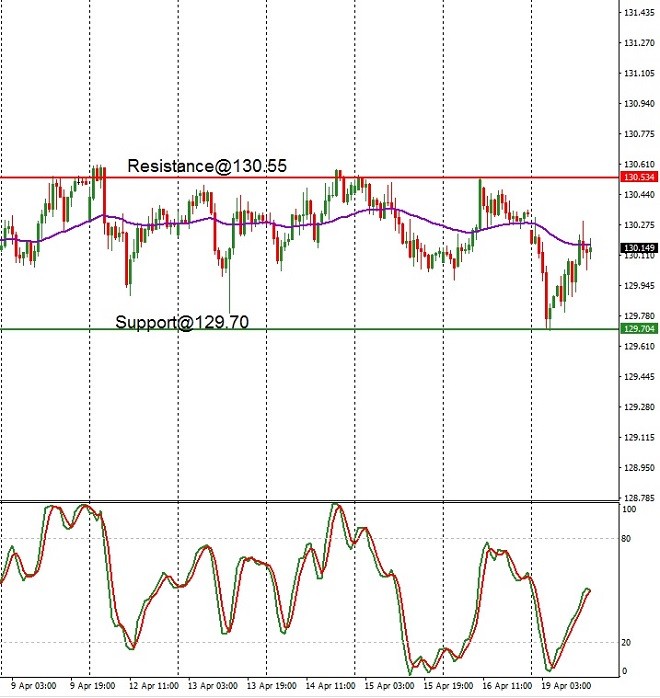
Also, concerns over the slow economic rebound of Japan are keeping the yen week. In the last 24 hours, the EUR/JPY remained range-bound between 129.70 and 130.30.
According to the Japanese Ministry of Finance, the country recorded a trade surplus (seasonally adjusted) of ¥0.30 trillion in March, following a deficit of ¥0.01 trillion in the prior month and more significant than the ¥0.20 trillion anticipated by economists.
Devoid of seasonal adjustment, trade surplus was ¥663.70 billion, exceeding the ¥493.20 billion surpluses anticipated by economists.
Data provided by the Ministry of Economy, Trade, and Industry indicates that industrial production shrank 1.3% m-o-m in February, following a contraction of 2.1% in the earlier month. Economists had anticipated no change in the industrial production data.
For the first time in over three years, the country’s exports recorded a double-digit rise in March as the rebound gained momentum in the prime overseas market.
Imports increased 5.7% y-o-y in March and surpassed the 4.7% rise anticipated by economists. The value of exports increased 16.1% y-o-y in March, driven by exports of plastics, cars, and non-ferrous metals. Economists had predicted an 11.4% rise.
Exports to China jumped 37.2% on a y-o-y basis. Likewise, Shipments to the US and the EU increased 4.9% and 12.8%, respectively.
Growing exports offer significant assistance for the country’s economy as delays in vaccination and rising fourth-wave of COVID-19 infections affect domestic activity.
The disparity between overseas and local markets was underlined last week by the machinery orders report indicating a decline in domestic orders, while those from overseas increased sharply.
In the future, rising US retail sales and demand from China, where economic growth surged by a historical high last quarter (compared with the comparable period last year), is expected to lead the country’s exports. Finally, a decline in the value of the yen is also expected to aid exports. In March, the yen declined by about 4% against the dollar, boosting the value of remitted profits.
According to the European Central bank, the Eurozone recorded a current account surplus of €25.90 billion in February, compared with a surplus of €34.70 billion in the prior month and lower than the €31.20 billion anticipated by economists.
Goods and services recorded a surplus of €32 billion and €11 billion, respectively. It was partially nullified by deficits of €2 billion in primary income and €16 billion in secondary income.
In the year ended February 2021, the overall surplus amounted to €259 billion (or 2.3% of euro area GDP), a decrease from €263 billion (or 2.2%) in the prior year.
The drop was led by a decline in the primary income surplus to €18 billion, from €48 billion, and a rise in the deficit for secondary income to €167 billion, from €151 billion.
An increase in surpluses partially nullified these advancements to €58 billion (from €36 billion) for services and €350 billion (from €330 billion) for goods.
The mixed economic data from both Europe and Japan is expected to keep the EUR/JPY pair range-bound with a slight bullish bias in the short term.
The EUR/JPY pair’s price chart indicates that the currency pair has bounced off the support at 129.70. The following minor resistance is anticipated only near 130.55. Additionally, the currency pair is trading above its 50-day moving average, while the stochastic oscillator is rising towards the bullish zone. Therefore, we anticipate the EUR/JPY pair to remain in an uptrend in the near term.
Disclaimer: Any financial trading analysis offered here is our opinion and is not intended as advice or direction for investors. We cannot guarantee the success of any trades made as a consequence of this article, and we encourage traders to incorporate a strong money management strategy to limit losses when they enter the markets. Please use this article as part of your own research before formulating strategies prior to trading.


