The Japanese yen rallied against the Eurodollar in the Asian session yesterday, following the report of overwhelmingly positive ‘economy watchers’ sentiment index by the Cabinet Office of Japan.
The Eurodollar’s decline was further fueled by worse-than-expected German industrial production data by Destatis. In the last 24 hours, the EUR/JPY pair declined from a high of 129.38 to a low of 128.83.
According to the Bank of Japan, bank lending increased 6.2% y-o-y in February, following an increase of 6% (downwardly amended from 6.1%) in the earlier month.
In value terms, outstanding loans held by four top categories of Japanese banks, including credit unions or “shinkin,” increased to ¥578.104 trillion. Devoid of trusts, bank lending increased 5.9% y-o-y to ¥502.25 trillion in February. In January, bank lending, excluding trusts, rose by 5.7%.
Lending from trusts increased 8.5% y-o-y to ¥75.853 trillion and borrowing from overseas banks declined by 4.7% y-o-y to ¥3.267 trillion.
According to the Japanese Ministry of Finance, the current account surplus (seasonally-adjusted) declined to ¥1.499 trillion in January, from ¥2.077 trillion in the earlier month. Economists had anticipated an increase in the current account surplus to ¥2.20 trillion.
The reported reading reflects the 79th successive monthly rise in current account surplus. However, the figure also represents the first drop in five months as travel restrictions to contain the pandemic had severely impacted revenue generated from the sector.
Notably, the services trade deficit widened to ¥480.9 billion in January, from the deficit of ¥142.2 billion recorded in a similar period last year.
Travel surplus was ¥25.0 billion in January, a decrease of 91.6% from ¥296.2 billion in the prior-year period. The primary income surplus also declined 22.1% y-o-y to ¥1.47 trillion.
Furthermore, Japan’s trade deficit narrowed to ¥130.1 billion in January, from a deficit of ¥990.4 billion last year. The reported figure reflects the first deficit in seven months.
Exports increased 2.7% y-o-y to ¥5.69 trillion, representing the second month of increase in a row. The growth was led by solid demand for semiconductor production machinery from South Korea and plastic from China. For the 21st successive month, imports posted a decline.
In January, imports fell by 10.9% y-o-y to ¥5.82 trillion. The decline in demand for clothing and drop in crude oil prices were responsible for decreasing imports.
According to Japan’s Cabinet Office, the leading indicators index rose to 99.1 in January, from 95.3 in December, surpassing the reading of 96.7 anticipated by economists.
The leading indicators index comprises 11 economic indicators that reflect new orders, stock prices, consumer confidence, employment, money supply, production, housing, and interest rate spreads.
Likewise, the coincident economic indicators index rose by 3.5 points from the earlier month to 91.7 in January. The indicator is made up of data about employment, factory output, and retail sales.
The country’s service sector sentiment (economy watchers) index rose to 41.30 in February, from 31.20 in January, and easily surpassed the reading of 34.20 anticipated by economists.
The participants in the survey are hotel workers, taxi drivers, and restaurant staff. They are called “economy watchers” because of their proximity to end customers.
In Europe, according to Destatis, German industrial production declined 2.5% m-o-m in January, following an increase of 1.9% in the earlier month and higher than the 1.4% drop anticipated by economists. On a y-o-y basis, production fell by 3.9% in January 2021.
Devoid of energy and construction production fell by 0.5% m-o-m in January. Production of capital goods decreased 0.8% m-o-m, while consumer goods dropped 3%. Intermediate goods posted a rise of 0.7%.
Also, energy production increased 0.6% for the reported period. The construction sector fell by 12.2% in January, amid a robust rise of 5.4% in December 2020.
According to Sentix, the leader in sentiment analysis (behavioral finance), the European investor confidence index rose to 5 points in March, after recording a reading of -0.2 in the earlier month.
Economists had anticipated only a slight improvement to 0.30 points. It is the highest recorded reading since February 2020.
The current situation index improved to -19.3 in March 2021, from -27.5 in the earlier month, reflecting the highest reading since March 2020. Expectations index improved to 32.50, from 31.50 in February. A reading below zero indicates pessimism, and a reading above zero reflects optimism.
The overall index for the world increased to 20.50 in March, from 17.50 in the prior month.
It is the 10th successive rise and the highest level since March 2018. Likewise, the global current situation index increased to 5.50 in March, from zero in February. It is the highest level since February 2020 and represents the 10th successive increase.
The mixed economic data from Europe and Japan is expected to keep the EUR/JPY pair range-bound with a slight bearish bias.
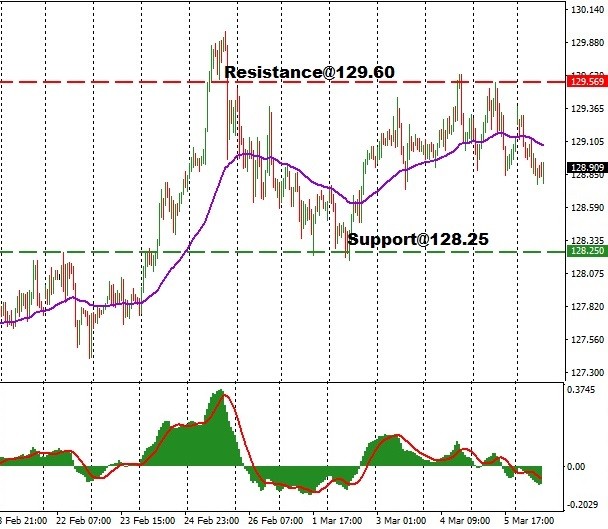
Technically, the EUR/JPY pair is declining after facing resistance at 129.60. The following support is anticipated only near 128.25. Additionally, the currency pair trades below its 50-day moving average, while the MACD indicator has a negative reading. Therefore, we are anticipating the EUR/JPY pair to remain in a downtrend in the short-term.
Disclaimer: Any financial trading analysis offered here is our opinion and is not intended as advice or direction for investors. We cannot guarantee the success of any trades made as a consequence of this article, and we encourage traders to incorporate a strong money management strategy to limit losses when they enter the markets. Please use this article as part of your own research before formulating strategies prior to trading.